
Yongha Kim’s Research on Salt Effects on Weak Polyelectrolyte Membranes Published in Soft Matter
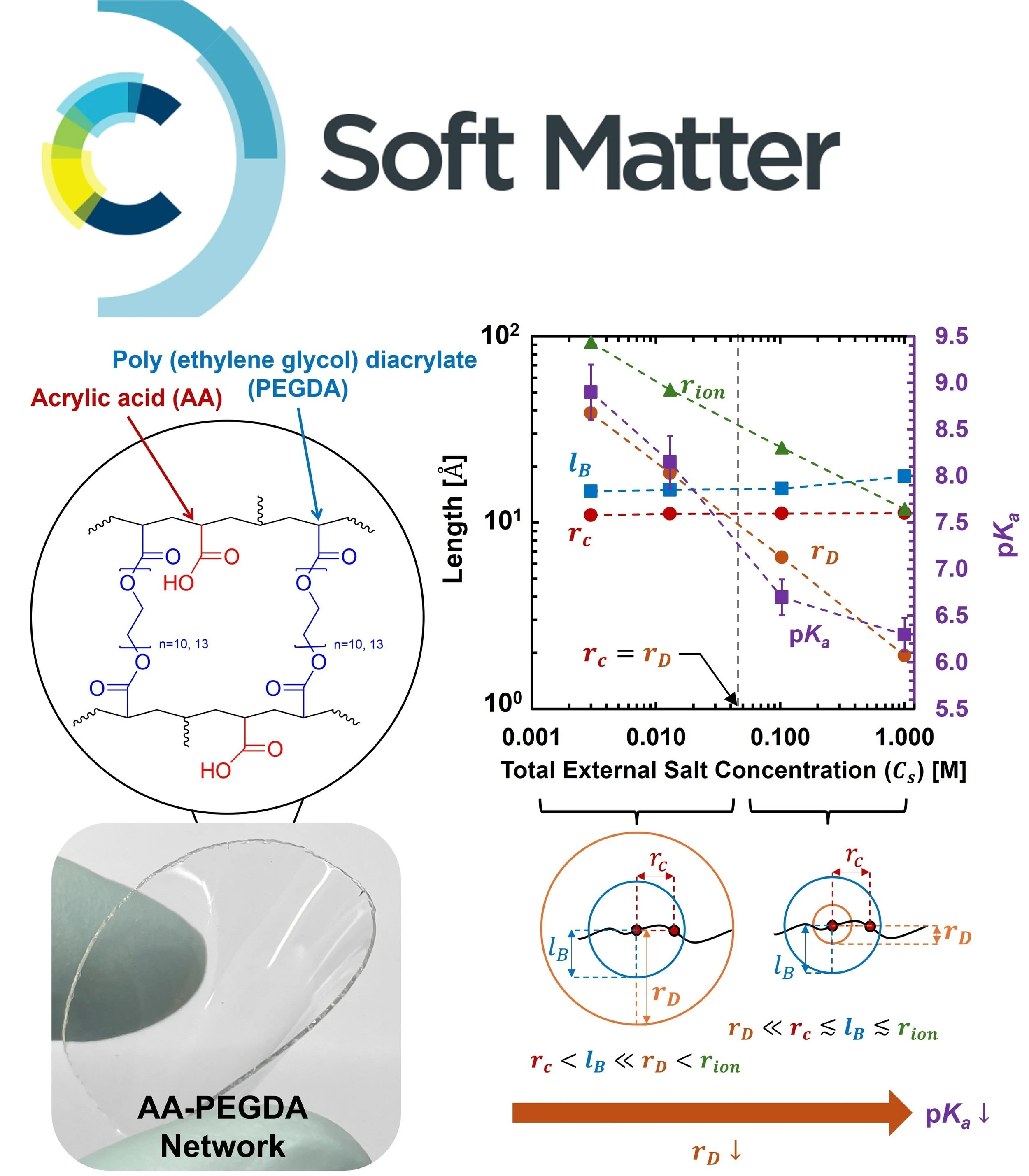
Yongha’s paper reports the effect of external salt concentration on the dissociation behavior in weak polyelectrolyte membranes.
The study, entitled “Effect of external salt solution concentration on carboxyl dissociation degree (α) and pKa of weak polyelectrolyte membranes for sustainable technologies” has been published in Soft Matter.
This study advances our understanding of dissociation in weakly charged polymer membranes—an essential step toward designing materials with tunable transport properties for sustainable technologies. It represents one of the first systematic, film-based investigations of dissociation behavior under precisely controlled external salt conditions. By directly linking molecular-scale electrostatic interactions to macroscopic ionization behavior, including measurable pKa shifts, the work establishes a clear structure–property relationship in these systems.
Our results demonstrate that salt-screened electrostatic interactions, rather than water swelling, govern dissociation across 0–1 M NaCl. This finding provides a quantitative physical framework for describing weak polyelectrolyte networks. More broadly, the study offers a predictive, physics-based foundation for tuning dissociation and guiding the rational design of next-generation charged membranes with tailored transport properties for sustainable applications.
This achievement is the result of dedicated teamwork led by Yongha Kim and supported by our talented undergraduate scientists, including Michael Shaqfeh, Nikitha Kanumuru, Andrew Lukaszewski, Dae Eun Kang, Kyle Tierney and Charleen Rahman. Thank you all for your hard work!
Warmest congratulations to Yongha and our talented undergraduate scientists! We are so proud of you!
About our work
We design and create high-performance membranes that enable unprecedented separation opportunities. We pursue fundamental breakthroughs that translate into real-world applications, always seeking to bridge the microscopic understanding of materials with macroscopic performance. Our goal is to make separations systems cleaner, stronger, and more sustainable.

About the Oh Lab
At the Oh Lab, we are dedicated to advancing the world’s most important, but challenging, separations in the environment, energy, and health sector. We do this by focusing on the molecular-to-macroscopic design and characterization of polymer membranes. We work at the intersection of chemical engineering, materials science, and molecular transport, focusing on designing advanced polymer membranes for efficient chemical separation.