
Adele and Evan’s Research on 3D Biosponge Adsorbers Published in ACS Biomaterials Science & Engineering
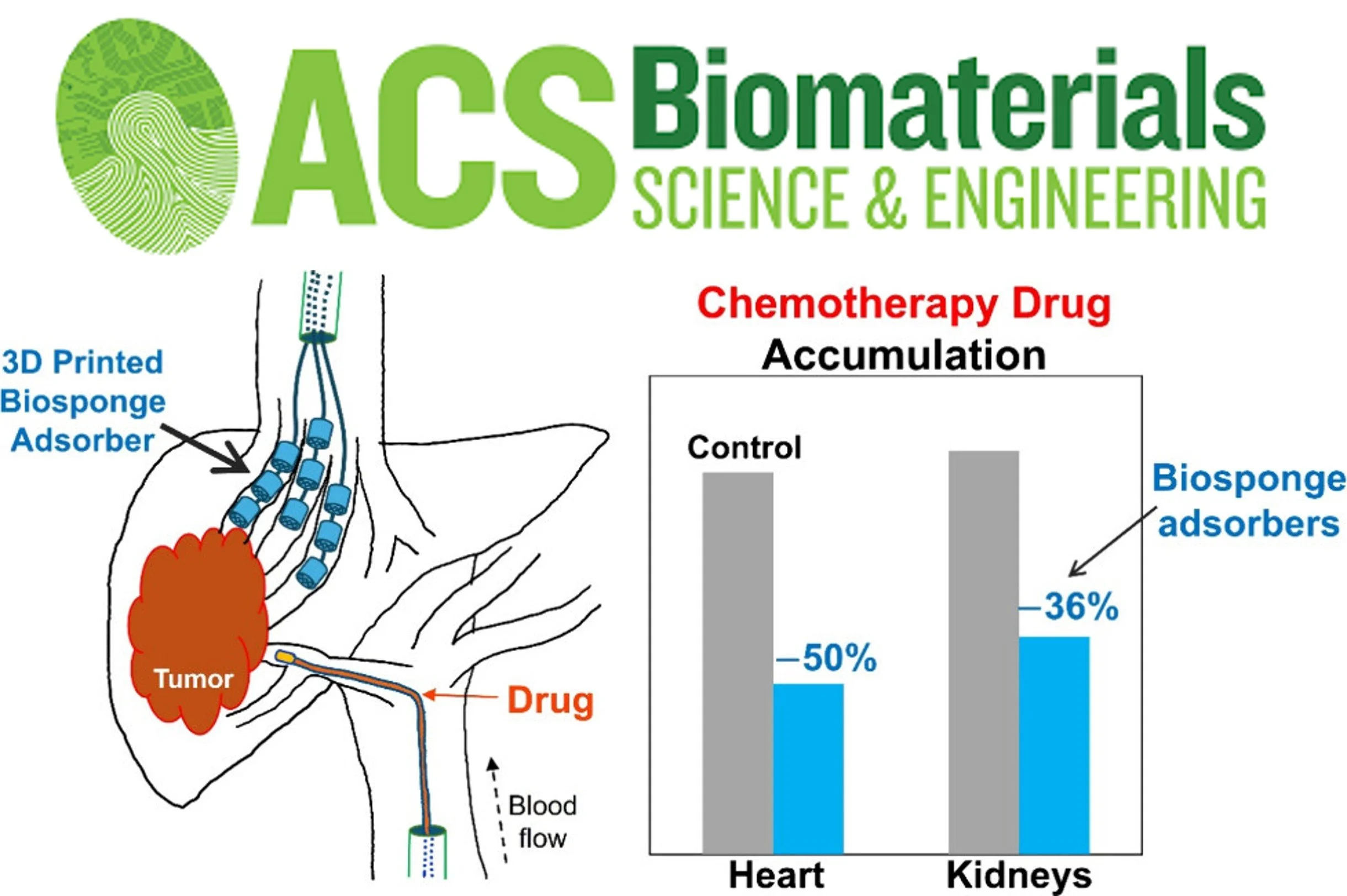
The paper reports the design of drug-selective biosponge adsorbers and the feasibility of in vivo adsorption approach to help people fight cancer.
The study, entitled “3D Printed Biosponge Adsorbers for Capturing Toxic Chemotherapy Drugs In Situ in the Body” has been published in ACS Biomaterials Science & Engineering.
Cancer remains the leading cause of death in many developed countries, and chemotherapy dosing is often limited by serious systemic side effects. We developed a 3D-printed “biosponge” adsorber designed to capture excess chemotherapy drugs in the bloodstream before they circulate to healthy organs. In a liver cancer model using doxorubicin, our device significantly reduced drug accumulation in the heart (50%) and kidneys (36%) without impairing blood flow. Cell studies confirmed reduced cardiotoxicity, supporting the feasibility of this in vivo adsorption approach. This platform offers a promising strategy to minimize off-target toxicity and enable safer, higher-dose locoregional chemotherapy for cancer patients.
This achievement is the result of dedicated teamwork, supported by our talented undergraduate scientists, Adele Godby and Evan Bhagat, and our colleagues, Prof. Steve Hetts group at UCSF Radiology and Biomedical Imaging including. Drs. Marian Aboian, Colin Yee, Teri Moore, Mark Wilson, Bridget Kilbride, Emile Decavel-Bueff, as well as, Jacqueline Maslyn, Whitney Loo, Michael Yee, Greg Robbins, Nitash Balsara and Joeseph DeSimone!
Warmest congratulations to Adele and Evan and our talented undergraduate scientists! We are so proud of you!
About our work
We design and create high-performance membranes that enable unprecedented separation opportunities. We pursue fundamental breakthroughs that translate into real-world applications, always seeking to bridge the microscopic understanding of materials with macroscopic performance. Our goal is to make separations systems cleaner, stronger, and more sustainable.

About the Oh Lab
At the Oh Lab, we are dedicated to advancing the world’s most important, but challenging, separations in the environment, energy, and health sector. We do this by focusing on the molecular-to-macroscopic design and characterization of polymer membranes. We work at the intersection of chemical engineering, materials science, and molecular transport, focusing on designing advanced polymer membranes for efficient chemical separation.